
Goals That Finally Match Reality: Start DUMB, Finish SMARTER
Do your SMART goals feel more like shackles than rocket fuel? What if your goal-setting system could energize your nervous system instead of draining it? Here we explore how the DUMB→SMARTER framework helps high-pressure leaders focus and execute.

We've all been there: meticulously crafting SMART objectives only to watch them gather dust by Q2 and be long-forgotten by Q4.
As an executive coach who has worked with over 450 leaders across industries, I see the same pattern show up again and again. This post offers an upgraded framework combining visionary thinking with execution designed for focus when everything is changing all the time. This is how we apply it inside the Potentializer Academy.
Why SMART Goals Are Failing You
The numbers don't lie. In a Leadership IQ survey of 12,801 people, only 30% felt a strong sense of urgency about their goals; the majority showed procrastination.
No wonder. SMART goals were popularized in the early 1980s (!), when aligning tasks with organizational priorities was simpler, and environments were more stable and predictable. Today, they collide with constant ambiguity and the overflow of unknown unknowns in this Age of Iteration.
Our brains do crave goals because they activate prefrontal focus and dopamine rewards. Yet traditional systems fail because they:
Crush innovation through hyper-specificity
Ignore energy rhythms and neurochemistry
Lack flexibility to adapt to quick changes
So we set goals that are vague "should do's," define huge ambitions, and then stare down endless to-do lists before we do something else entirely.
Or we don't set goals at all.
Despite over 1,000 studies confirming that specific, challenging goals outperform vague "do your best" intentions, most people still avoid formal goal-setting. Why? Fear of failure, poor self-image, not knowing why a goal matters or how to set one.
And still goals help us succeed. We need them.
So the real questions become:
How do we set goals we actually get excited to finish, not just declare?
How do we tap into the difference between what we could do, what we should do, and what we actually will do?
At the Potentializer Academy, we use a goal engine that combines DUMB foundations and revamped SMARTER execution. It's a blueprint for high-performers wanting neurochemistry, energy, and strategy on their side.
If you’re a senior leader or founder navigating complexity and pressure, this is exactly the kind of system we build together in my Potentialize Your Leadership and Ambiguity Masterclass programs.

Start DUMB: Where Neuroscience Meets Ambition
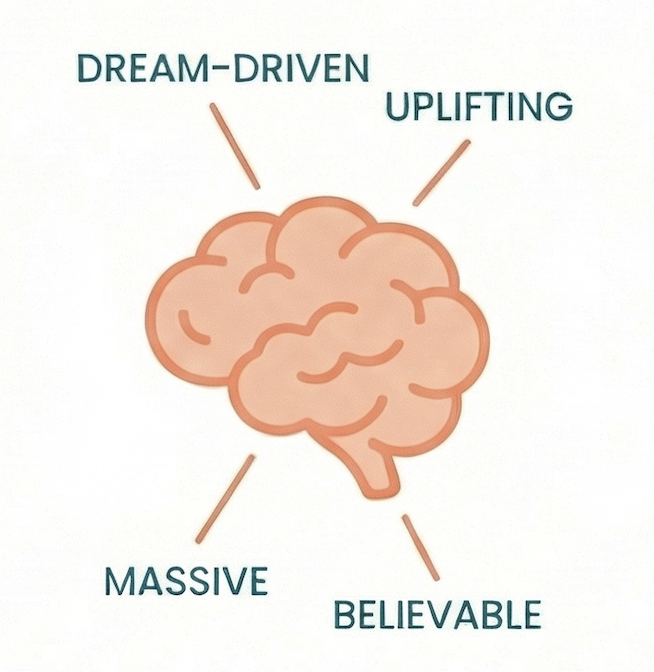
First, tap into the brain's reward system. Start with DUMB foundations (see below) by creating a transformational objective as a vision before you narrow down to tactics.
Think in terms of why and end-state mission. Zoom out in context and time span. Beginning with dreaming optimizes motivation, creativity, and achievement.
D = Dream-Driven
Goals tied to meaningful aspirations activate brain networks associated with creativity and motivation. When you temporarily drop the “how” and think in visionary, vivid scenarios, you:
Engage dopamine pathways that sustain effort over time
Spark more original ideas and expansive thinking
Make it easier to persist when things get hard
Goals aligned with your core values and interests are consistently linked to higher attainment and long-term wellbeing.
My clients who define a “dream-driven” leadership vision consistently re-prioritize, say no to low-value projects, and advance their careers more intentionally.
U — Uplifting
Positive emotions widen what we can see and try.
Joy sparks play
Interest sparks exploration
Contentment sparks integration.
Feeling uplifted and hopeful around a goal supports progress on complex, innovative work. When you frame goals as learning journeys or contributions to others, you tap into meaning-making and mattering, which are powerful intrinsic motivators.
Ask yourself: How can I frame this goal so pursuing it feels like an energizing experiment or contribution, not another obligation?
M — Massive
You need goals big enough to feel exciting and transformational, not incremental. Massive doesn’t mean fantasy. Goals need to be:
Big enough to feel meaningful
Grounded enough that you can imagine a path
We reach goals that challenge us just the right amount; if there’s no stretch, we get bored and disengage.
B — Believable
Massive and believable. Motivation is strongest when:
The goal is personally valued
You believe it’s achievable with focused effort and learning
High expectancy and self-efficacy are key: you genuinely believe, “I can get there if I commit, learn, and iterate.”
With these DUMB foundations, you capitalize on vision, positive emotion, and motivation, creating a goal you can actually commit to.
If you want a deeper dive into commitment, see my article: The Simple Commitment Hack That Can Help You Crush Procrastination for Good”
At the Potentializer Academy, we often anchor DUMB goals with the Meet Yourself™ assessment, which integrates genetics, neuroscience, and behavioral psychology so your ambitions are aligned with how you naturally think and thrive.
SMARTER Execution: Turning Vision into a Playable Game
Once you have a DUMB goal, it’s time to get tactical. Upgrade the SMART framework and narrow it to execution. Start by:
Chunking your big DUMB goal into smaller, manageable parts
Turning those parts into thin, executable slices (vary size or length)
Attaching slices to behaviors and systems
Don’t slice too many at a time; do it progressively to reduce cognitive load. Focus on progress goals (what I need to do consistently) over pure outcome goals.
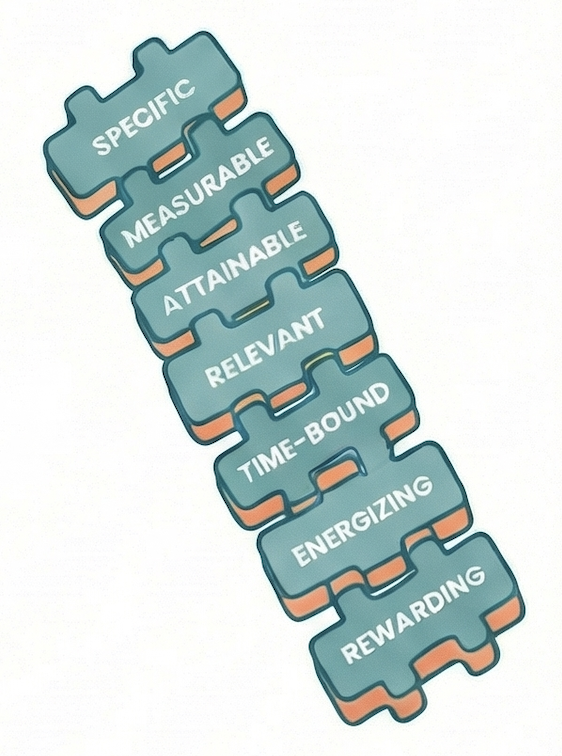
Then get SMARTER:
S — Specific
The S in SMART is strongly backed by research: clear, specific goals and visible sub-goals reliably boost performance and persistence. Our brains respond to concrete progress cues and upcoming rewards. We’re more likely to stick with goals that we can pursue step by step and see ourselves approaching.
The “goal-gradient” effect shows we often work harder as we get closer to a goal, especially when progress is visible.
Make it specific enough that you’d know, without debate, whether you did it or not.
M — Measurable
Measurable helps us change. That’s why 10,000 steps a day, although unfounded by science, works so well: we can measure it, we all know the target, and our devices call us out when we don’t meet it.
You can measure gains (more effective) or losses (useful for compliance or risk management). Either way, tracking makes behavior real.
In Potentializer Academy programs, we routinely track reclaimed focus hours, sustainable energy levels, and leadership effectiveness. Clients report a 30–50% sustainable energy boost, 8 to 12 hours of focus-time reclaimed weekly, and a 20%+ enhancement in productivity and effectiveness.
A — Attainable
If a goal is too hard, we get overwhelmed and give up. If it’s too easy, we get bored and limit our potential.
If you are hitting all of your goals, they are not hard enough. Some specialists suggest a 30% fail rate; Larry Page of Google once framed a 50%/50% rule (50% of goals with 50% failure). In a word, give yourself permission to fail.
I like to use levels:
Baseline: Minimum viable target
Stretch: Requires a push (30–50% lift)
Champagne: Outrageous (2x baseline)
Gamify them. As long as you hit the minimum, you celebrate (hear me, perfectionists, Baseline IS good enough). This gives the oomph to hit the Stretch, and push for Champagne.
R — Relevant
We are goal machines, but there's only so much we can do. Relevance keeps us honest. Ask:
Is the goal strategically important to my mission, purpose, project?
Will something important fail if I don't do this?
Is there a more vital goal?
Does this goal fit my skills, resources, and personality?
What is the opportunity cost and tradeoff?
Will the ROI in time resources, and energy be worth it?
Relevance lives in the here and now. And we all know reality changes. Regular recalibration (for example, biweekly "stop/start/continue" reviews) keep goals anchored in shifting conditions.
T — Time-bound
Deadlines leverage the brain’s response to time pressure, pushing us to prioritize action over procrastination. Open-ended goals fall prey to the “planning fallacy,” where we underestimate how long things take. Time-bound objectives counteract this by imposing constraints that align perception with reality.
Before committing, ask:
Why now? Is this the right time? Or the right goal at the wrong time?
What needs to happen first?
Is there another goal whose timing trumps this one?
Do I genuinely have time for this?
If it passes, draw up a timeline and double-check it against your real life.
Focus on the what and why; your brain will help find a how. Over-focusing on how at this stage can choke creativity. Get it on the calendar as process goals, not just outcomes.
E — Energizing
Sticking with goals is an energy and motivation game.
Goals work best when they tap intrinsic motivation, when we are doing something because it’s interesting and satisfying. That comes from agency, resources, and skills, plus leaning into how you operate at your best.
Ask: In what ways can I use my innate superpowers to do this?
Do the hard stuff when you have the most energy: early in the motivational cycle and at high-energy points in your circadian rhythm.
Traditional SMART can be too rigid for a changing environment and too repetitive for our novelty-seeking brains. Give yourself clear rules that protect commitment while allowing for flexibility and change.
At the Potentializer Academy, we call this energy optimization—aligning goals, schedules, and rituals with biological rhythms so leaders can lead from vitality, not depletion.
R — Rewarding
Make your system inherently rewarding. As we get closer to achieving our goals, our motivation naturally intensifies. Thin slices and visible milestones amplify this effect. So do celebrations.
Micro-celebrations (those tiny “Yes!” moments when you tick off a progress marker) act like mini-bursts of reward. They tap the same dopamine systems that respond to progress and anticipation, reinforcing behavior and increasing persistence over time.
Try this: Close your eyes. Imagine a big success you experienced and identify the sensation of excitement and celebration. You can call it up any time. Do so whenever you make progress toward your goal.
From Framework to Real-world Results
So there’s your DUMB→SMARTER system for setting goals.
No goal is achieved by setting it. Goals are achieved by consistently working toward them.
Inside the Potentializer Academy, we don’t stop at mindset. We:
Use science-based assessments like Brainprint™ and Meet Yourself™ to reveal innate strengths, mental drivers, and decision patterns.
Align goals and execution with biological rhythms and energy patterns.
Build anti-fragile systems and routines for thriving in ambiguity.
Track real-world metrics like reclaimed focus hours, sustainable energy, and team engagement.
Try a DUMB→SMARTER Experiment This Week
If you want to test this without overhauling your entire system, try just three steps this week:
Write one DUMB goal that feels both massive and believable.
Slice it into 3–5 tiny progress goals.
Put one thin slice in your calendar with a micro-celebration attached.
Notice:
What feels different about this compared to your usual goals
How your energy and focus respond
Where your system fights back (perfectionism, overwhelm, distractions)
Beyond Goals
Now that we have a framework that combines empirical evidence with practical application, ensuring your goals work with your brain's natural architecture, let's open our perspective to something else entirely.
Marshall Goldsmith notes, “What got you here won’t get you there... but who you become while trying just might.” What happens when you think about goals not as something to achieve, but as a vector for becoming?
In the end, it helps to shift our focus to loving the process, aligning with who we are, and doing our best. Take action, let go of rigid outcomes, and stop making your value as a human being conditional on results you achieve.
That’s where goals stop being shackles, and start becoming a playground for your potential.
You’re not stuck. You’re just not fully aligned...yet. DUMB→SMARTER goals can change that.
Ready to Potentialize Your Human Edge?
If you’re a senior leader, founder, or executive team navigating complexity, pressure, and constant change, this is the work we do every day at the Potentializer Academy:
Personalized, science-backed executive coaching and leadership development
Deep assessments (Brainprint™, Meet Yourself™) that reveal how you’re wired to thrive
A four-step Potentializer Framework—Reveal, Reboot, Rebalance, Reconnect—that turns complexity into strategic clarity, energy, and impact
I bring over 30 years of cross-industry experience, 2,250+ hours of 1:1 coaching, and work with 450+ leaders worldwide as a Certified Human Potential Coach, Professional Certified Coach, Certified Neurosensorial Coach and Management Consultant, Certified Heroic Coach, and Certified Meet Yourself® Axon Coach.
You can book a free strategy call with me here or email contact@annetrager.com